In today’s fast-paced healthcare environment, manual document processing in pharma remains one of the most critical operational bottlenecks. While the pharmaceutical industry is known for its cutting-edge research, many companies still rely on outdated, paper-based workflows. Consequently, compliance and quality assurance teams spend thousands of hours performing human-in-the-loop validation of manufacturing forms, cross-referencing entries against strict regulatory guidelines. This human-heavy process is not only prone to transcription errors but also consumes valuable expert time that could be dedicated to R&D and strategic quality initiatives.
The Massive Scale of Manual Document Processing in Pharma
First and foremost, the scale of the documentation challenge is immense. With thousands of pages of lab reports, shipping manifests, and quality certificates generated per batch, the current manual approach creates significant data silos. These silos make it near-impossible to achieve comprehensive traceability or perform rapid trend analysis across products. As a result, this leaves the organization vulnerable to regulatory scrutiny and inefficient recall processes. The cost of ‘bad data’ in this context is measured not just in dollars, but in patient safety risks and compromised product integrity. According to the FDA guidelines on Good Manufacturing Practices, data integrity is paramount.
The NexGen Architecture Solutions
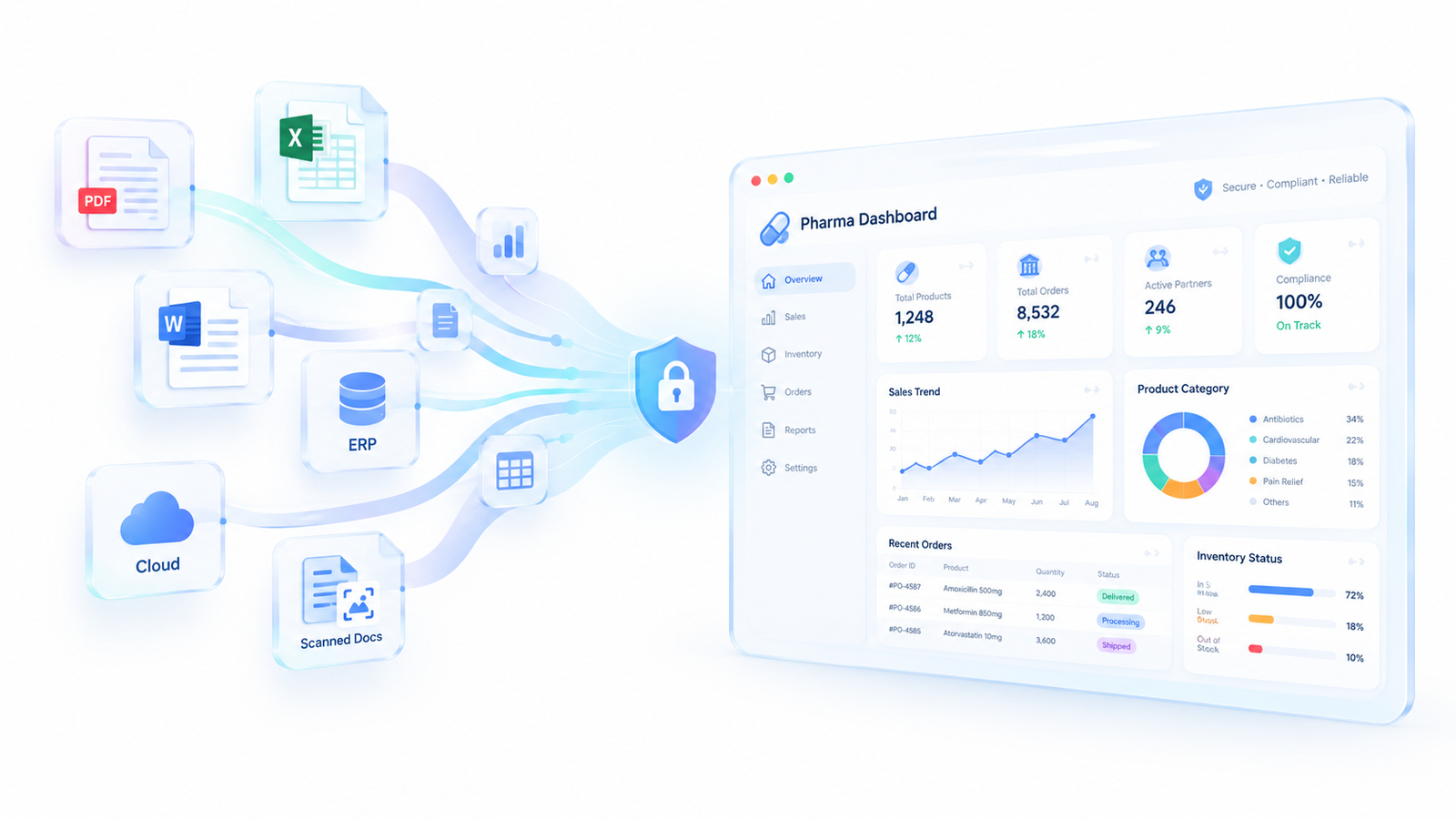
To directly address the issues associated with manual document processing in pharma, NexGen’s IDP (Intelligent Document Processing) pipeline leverages deep-learning models trained specifically on pharmaceutical documentation standards and medical nomenclature. Furthermore, our architecture automates the ingestion of structured and unstructured documents, utilizing advanced OCR and entity extraction to map data points from paper or PDF records directly into digitized, audit-ready databases. The system handles complex table structures and handwriting, which have historically been the most significant barriers to automation in this space. For more information on how we implement this, check out our Intelligent Document Processing & NLP solutions.
Zero-Touch Verification
Crucially, our platform includes a compliance-validation layer that performs ‘zero-touch’ verification. The system instantly flags discrepancies between recorded manufacturing parameters and the established Master Batch Record (MBR). If a value falls outside the predefined operating ranges, the system halts processing and elevates the record for human intervention, providing the reviewer with the specific data point in question and the corresponding deviation rule.
QMS Integration
Furthermore, our solution integrates directly with the firm’s existing Quality Management System (QMS). By automating the ingestion and classification of quality certificates, we provide an end-to-end audit trail. The agentive layer also compiles comprehensive summary reports automatically, drastically reducing the preparation time for regulatory audits and quality reviews.
Quantified ROI & Business Impact
Pharmaceutical clients utilizing our IDP pipeline have experienced a 75% reduction in time spent on batch record verification. Therefore, by automating the data entry and initial validation, QA teams have reallocated 60% of their bandwidth toward high-value process improvement and analytical roles. Accuracy rates for data transcription, once a source of significant rework, have reached 99.9%—effectively eliminating human error as a significant compliance risk. Beyond labor savings, the digitization of this data enabled the company to run real-time analytics across product lines. They can identify process drifts 40% faster than previous methodologies, which directly mitigated potential inventory loss.
Conclusion: Moving Beyond Manual Document Processing in Pharma
In conclusion, the digitization of pharmaceutical documentation is the single most effective way to drive quality and efficiency simultaneously. By stepping away from manual document processing in pharma and leveraging NexGen’s intelligent solutions, life sciences leaders can achieve a level of transparency and operational resilience that was previously unattainable through manual processing alone.