
The Industry Bottleneck
In modern manufacturing, every second of unplanned downtime on the assembly line translates directly into lost revenue and strained supply chains. Traditional maintenance schedules, often based on rigid time-intervals, either lead to unnecessary service cycles or, more critically, fail to catch progressive mechanical failures that occur between inspections. For mid-size plants operating at scale, the operational blind spots created by these legacy approaches result in millions of dollars in inefficiencies and disrupted productivity.
The fundamental challenge lies in the sheer volume of telemetry data generated by modern industrial machines—vibration, temperature, and acoustic signals—which remains largely siloed. Without advanced intelligence to synthesize this data, maintenance teams are relegated to a reactive posture, addressing critical failures only after the machinery has already ceased operation. This gap between asset health monitoring and operational strategy is where profitability erodes.
The NexGen Architecture
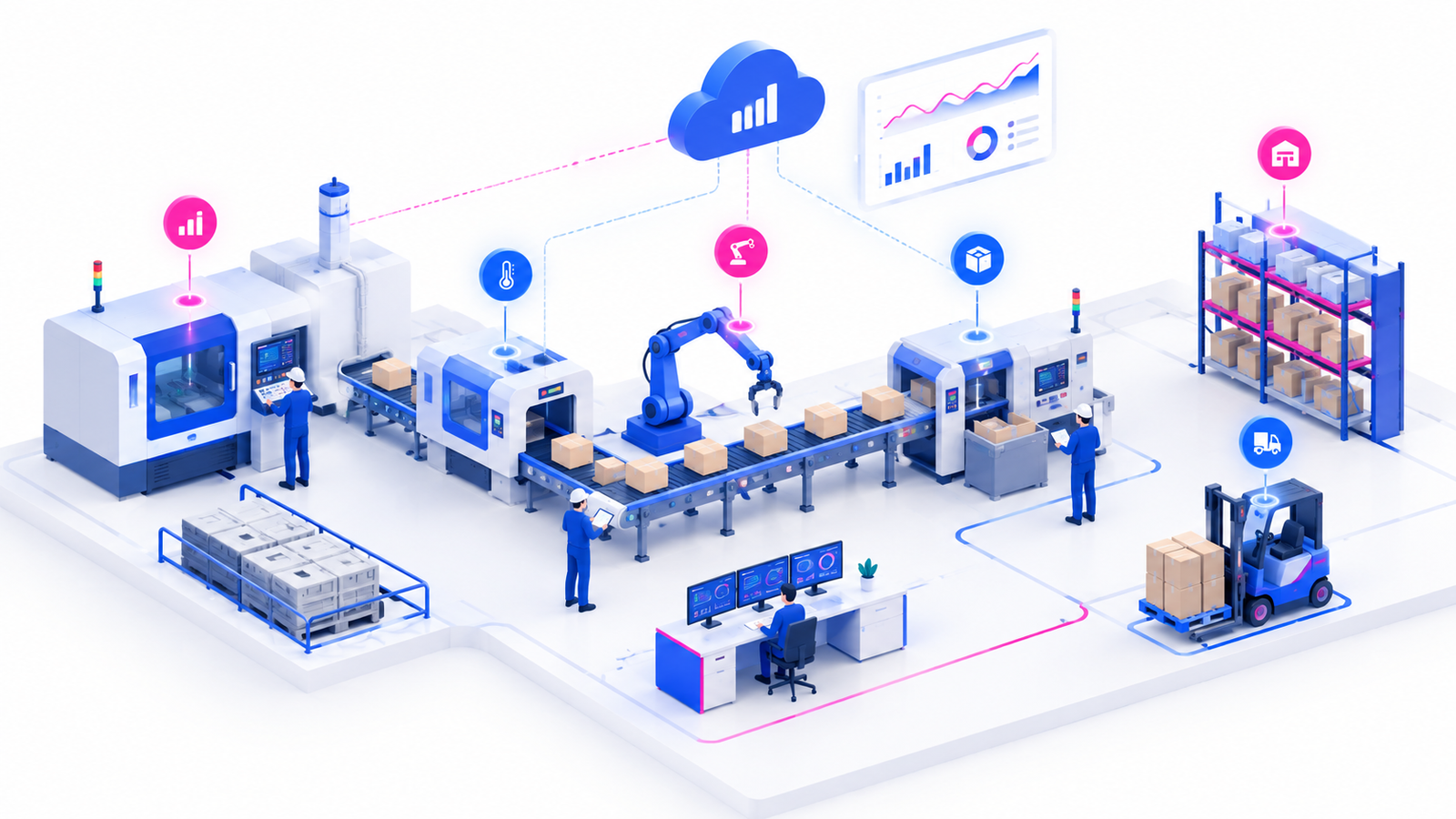
Our solution integrates high-fidelity sensor ingestion pipelines directly with enterprise ERP systems to build a continuous asset-health profile. By deploying edge-computing nodes, we perform real-time signal processing on equipment vibration and thermal streams, capturing microscopic anomalies that precede structural failure. This raw data is fed into a custom-built predictive analytics model trained on historical failure modes, enabling precise Remaining Useful Life (RUL) forecasting.
At the core of the NexGen architecture is an autonomous alerting engine that maps equipment health metrics directly to the plant’s production schedule. Unlike off-the-shelf anomaly detectors, our models prioritize failure alerts based on the criticality of the production line. If an imminent failure is detected, the system automatically triggers a work order in the ERP, schedules the required spare parts, and highlights the optimal maintenance window that minimizes disruption to ongoing production flows.
We further augment this with a GenAI-driven diagnostic layer. When an anomaly is detected, the agent generates a natural-language brief for technicians, detailing the specific components at risk, the probable cause, and step-by-step repair guidance. This eliminates the ‘search and diagnostic’ lag, allowing maintenance staff to arrive at the machine with the correct diagnosis and the necessary tools already in hand.
Quantified ROI & Business Impact
By implementing this predictive framework, our recent client engagement saw an immediate 41% reduction in unplanned downtime within the first six months. By moving from a scheduled maintenance cycle to a condition-based approach, the company extended the operational lifecycle of critical assets by 18%, deferring capital expenditures (CapEx) by two full quarters. Beyond direct maintenance savings, the enhanced reliability of the assembly line improved throughput consistency, directly resulting in a 12% improvement in overall equipment effectiveness (OEE). The combined reduction in emergency repair labor costs and optimized spare-parts inventory management provided a full return on investment in less than nine months.
Conclusion
Transitioning from reactive maintenance to intelligent, data-driven forecasting is no longer a luxury—it is an industrial necessity for competitiveness. By leveraging NexGen’s predictive architecture, manufacturing leaders can finally transition from fighting daily equipment fires to orchestrating highly efficient, resilient operations.