

The Industry Bottleneck
In the pharmaceutical industry, the batch record is your most critical document. It is the proof of patient safety, the backbone of CDSCO compliance, and the primary focus of every quality audit. Yet, for many mid-size manufacturing plants, these records are a nightmare of manual data entry, handwriting interpretation, and cross-referencing. A single error in a calculation or a missed sign-off can halt an entire release, leading to days of internal investigation and lost revenue.
Consider a plant producing 400 batches a month. If quality assurance (QA) personnel spend two hours per record checking for completeness and accuracy, that is 800 hours—nearly five full-time employees—dedicated solely to paperwork. This is not just a high operational cost; it is a significant risk surface. Every manual step is a potential data integrity violation waiting to happen during an unannounced regulatory audit.
The NexGen Architecture
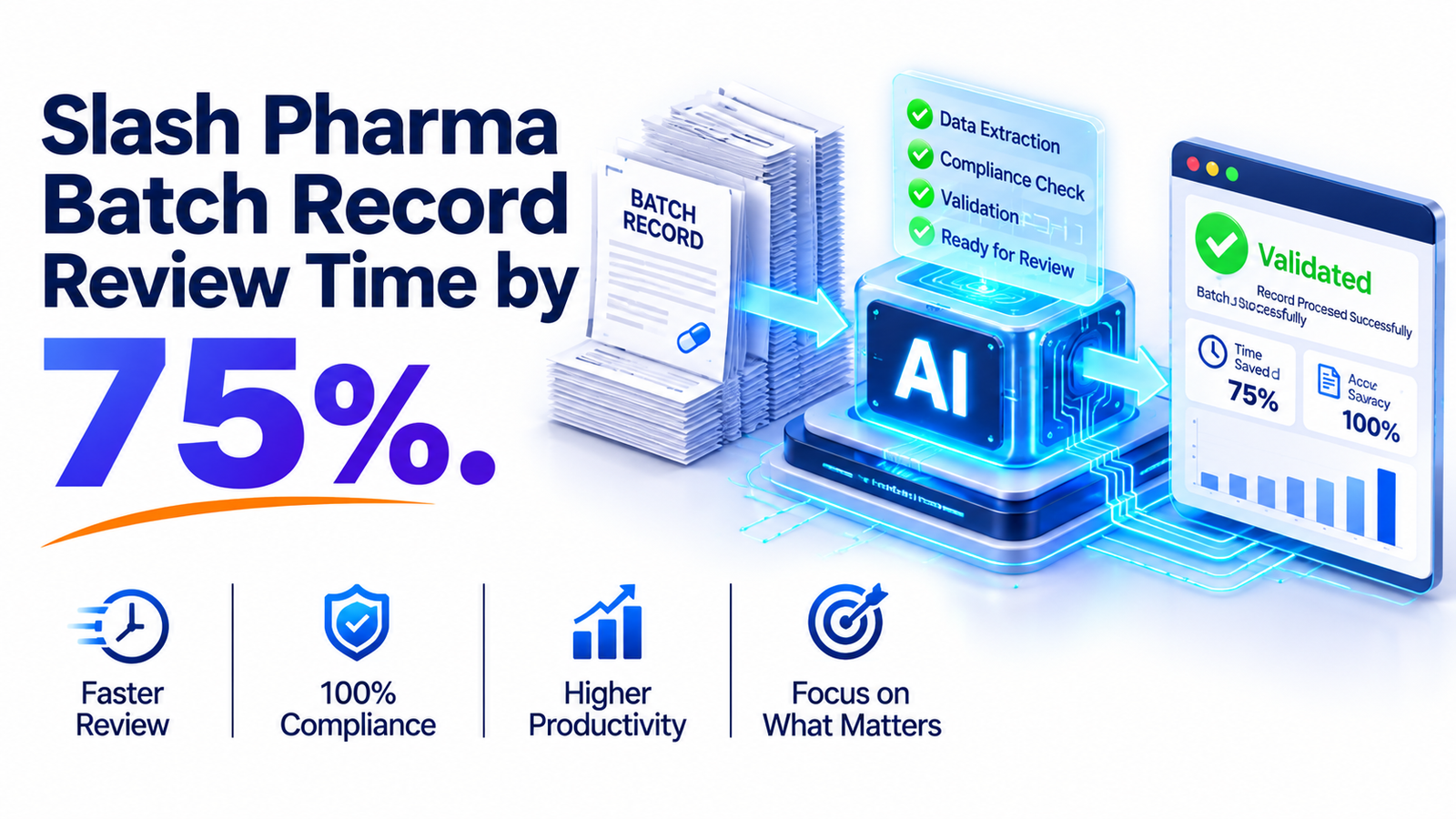
We transform batch records into structured data using LayoutLM-based document intelligence. The pipeline automatically extracts key parameters like temperature logs, chemical yields, and operator timestamps from scanned records, instantly cross-referencing them against established SOP limits. Integration with your LIMS (Laboratory Information Management System) or ERP ensures that real-time process data matches the paper record, flagging anomalies before they become critical errors.
Our human-in-the-loop architecture provides your QA team with a ‘confidence dashboard’ that highlights only the exceptions. Instead of reading every line, an inspector simply reviews the 2% of data points that fall outside specific process tolerances. This architecture allows your most experienced quality professionals to focus on strategic compliance tasks rather than simple data transcription. The entire workflow integrates seamlessly into your existing digital environment, providing an audit trail that is mathematically robust and perfectly ready for digital submission.
Quantified ROI & Business Impact
- Reduction in manual QA review time by 75–80%.
- Prevention of audit findings related to data entry or transcription errors.
- Typical yearly savings of ₹35–45 lakh per facility in personnel productivity.
- Elimination of data integrity gaps in batch release workflows.
- Faster batch release cycle, moving from days to hours.
Conclusion
Pharma quality management should be driven by technical expertise, not manual labor. By automating the batch record review process, you ensure consistent compliance and free up your workforce for higher-value analysis. Book a free 30-minute AI feasibility assessment at nexgendataminds.com.